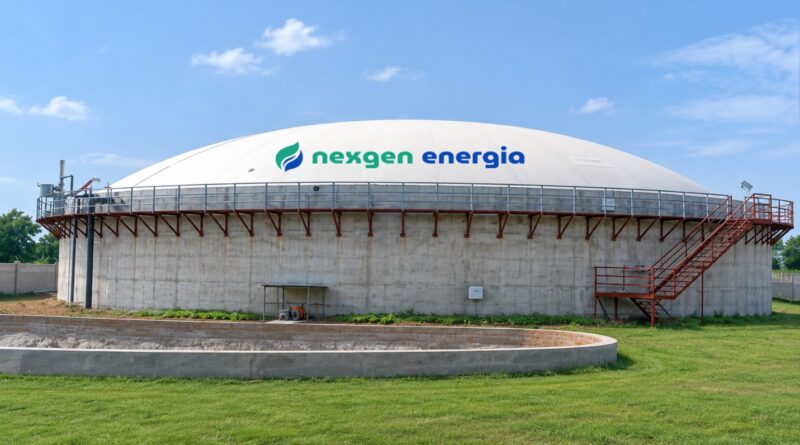
Powering India’s Energy Freedom
Image caption – NexGen Energia Ltd. on waste, wealth and the road to energy self-reliance
As India marks this Independence Day under the theme ‘Honouring Freedom, Inspiring the Future’, we asked NexGen Energia Ltd. — the Noida-based Compressed Biogas (CBG) company betting on India’s agricultural waste as a source of energy self-reliance — to reflect on its journey, its philosophy, and its place in the country’s clean energy transition.
1. Company genesis
NexGen Energia Ltd. was incorporated in February 2019 to address three problems at once: India’s dependence on imported fossil fuels, the country’s mounting agricultural and organic waste, and the annual crop-residue burning that chokes North Indian skies every winter. The founding conviction was that India’s landfills and farms were not liabilities but green fuel fields waiting to be tapped — an insight that shaped NexGen’s core business of converting organic waste into Compressed Biogas (CBG), green diesel and bio-fertiliser.
2. Corporate profile
Headquartered in Noida with a registered office in Mumbai, NexGen Energia has grown from a single CBG proposition into a diversified clean-fuel platform spanning CBG/Bio-CNG manufacturing and retail, green diesel, bio-coal, EV charging and lubricants. Its first CBG plant was commissioned in Gorakhpur, Uttar Pradesh, with plants now also running in Haridwar and Chennai. Its current plan includes a ten-project portfolio of 10 and 20 TPD CBG plants across Uttar Pradesh, Bihar and Rajasthan — anchored by sites at Bulandshahr, Fatehgarh, Balrampur, Arrah, Kota and Bikaner — at an indicative capex of ₹1,000 crore, with plants at Vijayawada, Indore and Rajkot slated for commissioning by the end of this year.
3. Vision and mission
NexGen Energia describes its vision as being “a catalyst for positive change… driving the transition to a sustainable future through biofuels, electric vehicles, and responsible water management.” Its mission translates that ambition into practice: to be a driving force in India’s shift to renewable energy, empowering entrepreneurs — from farmers to first-time investors — to set up CBG plants that cut fossil-fuel dependence while converting organic waste into a source of income.
4. Challenges and resilience
NexGen entered a sector where ambition has outpaced execution: even with over 200 CBG plants commissioned nationally, capacity remains a fraction of what India’s biomass base could support, held back by capital intensity, feedstock-aggregation bottlenecks and long commissioning cycles. The government’s newly approved GOBARdhan National Circular Bioenergy Scheme — a ₹23,731 crore, ten-year push for nearly ten-fold growth in domestic CBG production — is designed to close that gap. NexGen’s own response has been an asset-light execution model — partnering with landowners rather than acquiring land outright, while retaining full control of design, installation and operations — which has let the company move from a single commissioned plant to a multi-state pipeline without the capital drag of a land-heavy balance sheet.
5. Key achievements
Milestones include commissioning its first CBG plant in Gorakhpur, with plants now also running in Haridwar and Chennai; a plan to invest ₹1,000 crore in CBG pumps over a decade; and a nationwide multi-fuel retail stations initiative in collaboration with Oil & Gas PSUs. Three further plants — at Vijayawada, Indore and Rajkot — are slated for commissioning by the end of this year, alongside a ten-project portfolio of 10 and 20 TPD CBG plants taking shape across Uttar Pradesh, Bihar and Rajasthan.
6. Success philosophy
NexGen’s USP is structural: rather than building and operating plants alone — or requiring partners to also arrange land — it partners directly with landowners holding roughly 10 acres per site, while NexGen itself designs, installs and operates the plant end-to-end. Where most EPC players hand a plant over once it is commissioned, NexGen’s forte lies specifically in operations — running the digesters, upgrading systems and offtake logistics for the plant’s working life, not just installing and commissioning the machinery. That land-partner model, layered onto India’s new GOBARdhan policy tailwinds, lets the company scale a pipeline of owned-and-operated plants without the capital and time lag of outright land acquisition, while giving landowners a stake in a long-term revenue stream — and NexGen full control over execution quality and commissioning timelines. “We are actively looking to partner with landowners who can offer around 10 acres for a CBG plant — NexGen handles the design, installation and operations end-to-end, and the landowner gets a long-term stake in the revenue,” says Anand Dwivedi, Spokesperson, NexGen Energia. Landowners interested in exploring this opportunity can write to [email protected] or visit the company’s website.
7. Innovation and technology
NexGen’s CBG plants use anaerobic digestion — the same dome-digester architecture already operating across India’s commissioned CBG fleet — to convert agricultural residue, food waste and animal manure into raw biogas. Its digester technology extends further to spent wash and stillage, the effluent generated by both molasses-based and grain-based distilleries, widening its addressable feedstock base well beyond agricultural residue and municipal waste. For gas upgrading, the company has access to VPSA (Vacuum Pressure Swing Adsorption), membrane separation and amine-scrubbing technologies through associations with technology partners including Thermax and Paques, giving it a choice of purification routes suited to different feedstock and plant-size combinations. Newer projects in its pipeline also diversify beyond fuel and fertiliser sales into briquette sales to industries and aggregators, aimed at better realisations from digestate.
8. Inclusive leadership
NexGen’s land-partner model is, by design, a distributed one: it opens plant ownership and retail operation to first-generation entrepreneurs, farmers, landowners and small-town investors rather than only large corporates, across states as varied as Uttar Pradesh, Uttarakhand, Haryana, Maharashtra and Madhya Pradesh. Widening who gets to build India’s energy infrastructure is a consistent thread across the company’s public communication.
9. Global outlook
NexGen’s international outlook is expressed chiefly through technology rather than geography: its access to VPSA, membrane and amine gas-upgrading routes via its technology partners gives its India-first, land-partner build-out an internationally benchmarked technology stack.
NexGen frames its core business as a social-impact proposition in itself: CBG plants let farmers monetise crop residue instead of burning it, generate bio-fertiliser and briquettes alongside fuel, and create rural income tied to waste management. Its land-partner model extends this further, bringing waste-to-energy infrastructure to landowners and communities who would otherwise have no route into the sector. Beyond enabling others, NexGen’s own ambition is to grow a directly owned-and-operated portfolio — the plants already running in Gorakhpur, Haridwar and Chennai, the three more due by year-end in Vijayawada, Indore and Rajkot, and the ten-project pipeline of 10 and 20 TPD plants across Uttar Pradesh, Bihar and Rajasthan together marking early steps toward a much larger self-owned CBG footprint nationally.
11. Industry impact
NexGen has positioned itself among the more aggressive private players in India’s still-nascent CBG sector, where execution has broadly lagged government ambition — barely a quarter of the Letters of Intent OMCs have issued nationally have converted into operating plants. By pairing an asset-light, land-partner execution model with a concrete, multi-state pipeline — commissioned plants in Gorakhpur, Haridwar and Chennai, three more due by year-end, and a ten-project portfolio of 10 and 20 TPD plants taking shape — the company has pushed toward the front of a field still dominated by public-sector oil marketing companies and a long tail of small, undercapitalised developers.
12. Societal contribution
The through-line across NexGen’s activities — CBG, green diesel, bio-fertiliser, EV charging — is import substitution and energy security: less reliance on imported crude and gas, income for farmers and landowners who would otherwise burn residue or leave land under-used, and decentralised energy infrastructure reaching towns like Gorakhpur and Haridwar rather than only metros. India’s growth will demand a rising share of global energy even as the country works to cut oil imports, currency outflows and emissions — the gap NexGen positions itself to help fill, one commissioned plant at a time.
13. ‘Honouring Freedom, Inspiring the Future’
For NexGen, that theme reads almost literally as energy freedom. Every CBG plant it builds is, in effect, a small act of import substitution — biomethane brewed from Indian crop residue and cattle waste standing in for gas that would otherwise be shipped in. That idea links reduced oil imports and currency outflows to national resilience. Seventy-eight years after independence, NexGen’s pitch is that the next chapter of freedom will be measured in energy self-reliance — and it wants CBG to be part of writing it.
For enquiries
NexGen Energia Ltd
Contact: +91 88005 99662
Email: [email protected]
Website: www.nexgenenergia.com