
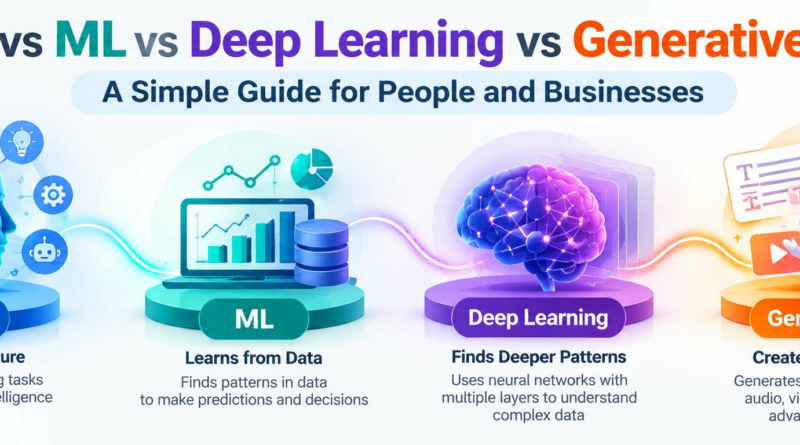
AI vs ML vs Deep Learning vs Generative AI: A Simple Guide for People and Businesses
Understanding what each technology does, how they differ, and where businesses can use them.
Article by Blue Sun Info (www.bluesuninfo.com)
A visual overview of four related technologies and their different roles.
Introduction
Artificial intelligence has moved from research labs into everyday digital life. It can help power voice assistants, product recommendations, fraud alerts, customer-support tools and systems that draft text or create images. Yet Artificial Intelligence (AI), Machine Learning (ML), Deep Learning (DL) and Generative AI are often used as if they mean the same thing. They do not. Each describes a different idea, and understanding the distinctions helps students, professionals and businesses judge what a technology can—and cannot—do.
Artificial Intelligence: The Broad Field
Artificial intelligence is the broad field of building computer systems that perform tasks associated with human intelligence, such as recognising patterns, understanding language, solving problems or making recommendations. AI does not always learn from data. A simple rule-based system, for example, may route a customer query according to conditions written by a programmer. Other AI systems use machine learning or deep learning to find patterns and respond to more complex inputs.
Machine Learning: Learning from Examples
Machine learning is a subset of AI in which systems learn patterns from data and use them to make predictions, classifications or decisions, rather than relying on a programmer to specify every rule. Businesses use ML for demand forecasting, detecting unusual transactions, estimating customer churn and recommending products. Models may learn from labelled examples, discover structure in data or improve through feedback. Traditional ML often works with structured information—such as sales figures, prices and customer records. People may need to select, clean and transform useful inputs, a process known as feature engineering.
Deep Learning: Learning Complex Patterns
Deep learning is a specialised branch of machine learning that uses artificial neural networks with multiple layers. During training, the network adjusts internal parameters to improve its ability to recognise patterns. With enough suitable data, these layers can learn useful representations from complex inputs, reducing the need for people to define every feature manually. Deep learning is widely used with images, audio, video and natural language, including speech recognition, image classification and many advanced language systems. It can be powerful, but training and operating large models may require significant computing resources, careful evaluation and specialist expertise.
Generative AI: Creating New Content
Generative AI refers to systems designed to create new content—such as text, images, audio, video or computer code—in response to prompts or other inputs. Many modern generative systems use deep-learning models trained on large datasets. Instead of only predicting a number or assigning a category, they generate an output based on patterns learned during training. Common uses include drafting an email, summarising a document, brainstorming campaign ideas, producing a first draft of product copy or assisting a developer with code. The output still needs review: generative systems can invent facts, miss context or produce material that is unsuitable for a particular audience.
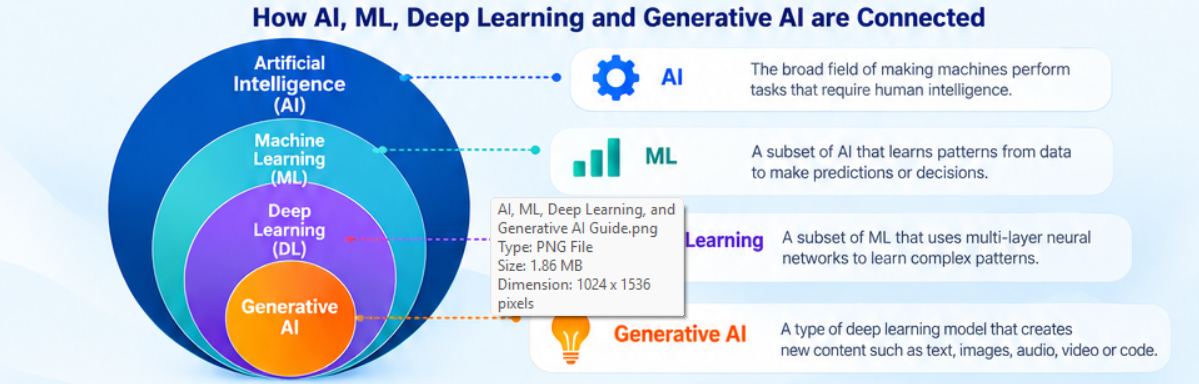
Artificial Intelligence (AI) is the broader field of technology that enables machines to perform intelligent tasks. Machine Learning (ML) is a subset of AI that learns patterns from data to make predictions or classifications. Deep Learning (DL), a subset of ML, uses multi-layer neural networks to recognise complex patterns. Generative AI uses learned patterns and prompts to create new content, such as text, images and product descriptions.
Together, these technologies enable applications ranging from automated decision-making and demand forecasting to image recognition and content generation.
These categories overlap, but they are not interchangeable. AI is the broadest field; ML is one approach within AI; DL is a specialised form of ML. Generative AI describes a capability—creating content—and many, but not all, generative systems are based on deep learning.
One Retailer, Four Different Uses
Consider an online retailer preparing for a busy shopping season. A rule-based AI tool could direct routine customer questions to the right help page. A machine-learning model could analyse historical sales, discounts and seasonal trends to estimate how much stock will be needed. A deep-learning model could recognise products in customer-uploaded photographs or help categorise images. A generative AI tool could draft product descriptions or suggest alternative campaign headlines. These examples show why the useful question is not simply “Which AI is best?” but “Which task needs to improve, and what evidence will show that it has improved?”
Where Businesses May See Practical Value
In digital marketing, existing machine-learning features can help with audience analysis, bidding and campaign optimisation, while generative tools can assist with brainstorming, first drafts and summarising research. In websites and mobile applications, AI-enabled services may support conversational interfaces, document summarisation, language processing or image-based search. In internal operations, teams may use search and summarisation tools to navigate policies, proposals and other documents. Some capabilities are available through existing software or application programming interfaces (APIs); a business does not necessarily need to train a model from scratch.
For company documents, retrieval-augmented generation (RAG) can retrieve relevant source material to help inform a generative system’s answer. It is not a guarantee of correctness. Source quality, permissions, data security and human verification remain important.
What to Consider Before Adopting AI
Start with a defined business problem, not with a fashionable technology. Decide what outcome matters—such as fewer repetitive enquiries, better demand forecasts, or faster document review—and establish a baseline so results can be measured. Assess whether the data is accurate, current, and appropriate to use. Consider privacy, cybersecurity, copyright, access controls, integration costs, and the consequences of an incorrect output. Test a tool on a limited, realistic workflow before relying on it more widely, and make clear when a person must review or approve its work.
Generative AI deserves particular care because fluent language can sound convincing even when it is wrong. Do not automatically treat its output as verified information, and avoid entering confidential or personal data into a service unless its terms and security controls have been assessed. Human oversight is especially important for customer commitments, financial decisions, legal material, and public-facing claims.
The Role of Digital Foundations
AI is only one part of a wider digital strategy. Websites, mobile applications, analytics, customer workflows, and reliable data practices can provide the foundation on which businesses evaluate and use new tools. Blue Sun Info, which works in website development, mobile applications, and digital marketing, encourages businesses to begin with clear objectives and a practical understanding of the technology rather than adopting AI simply because it is trending.
Conclusion
AI, machine learning, deep learning and generative AI are connected, but they are not synonyms. AI is the broad field; ML learns patterns from data; DL uses multi-layer neural networks to learn complex patterns; and generative AI focuses on creating content. The most suitable approach depends on the problem, data, cost, risk and expected result. Understanding the differences makes it easier to ask better questions, set realistic expectations and evaluate technology on its actual value.
Article by Blue Sun Info
Blue Sun Info (www.bluesuninfo.com), established in 2002, is a Mumbai-based IT and digital marketing company offering website and app development, SEO, AIO, GEO, digital marketing, CRM, ERP and customized business software solutions. Its associated businesses include JLN Mfg (www.jlnmfg.com), a 6-year-old B2B trading and supply business specializing in customized promotional products, yoga mats, umbrellas and corporate gifts, and Placement Mumbai (www.placementmumbai.com), a 16-year-old recruitment and placement company.


