CSIR–NIST and Bio Vastum Solutions Partner to Introduce Breakthrough Biomedical Waste-to-Soil Technology
Thiruvananthapuram: CSIR–National Institute for Interdisciplinary Science and Technology (CSIR–NIST) has entered into a collaboration with Angamaly-based startup Bio Vastum Solutions to deploy a globally patented technology for the safe conversion of biomedical waste into a soil substitutes.
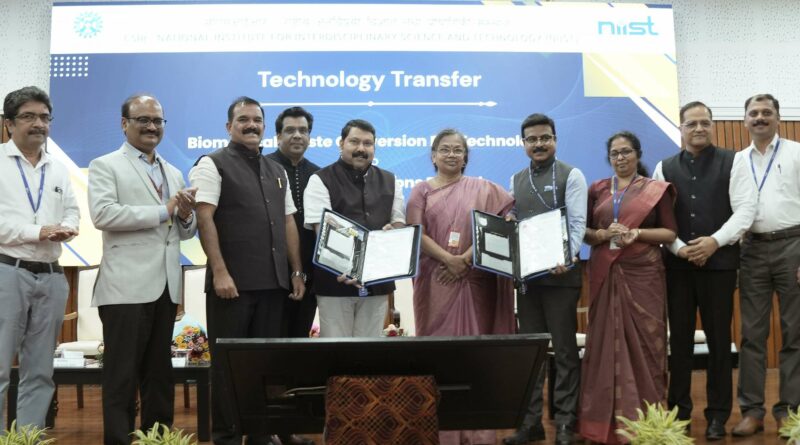
The technology transfer agreement was formally handed over by Dr. N. Kalaiselvi, Secretary, Department of Scientific and Industrial Research (DSIR) and Director General, CSIR, to Dr. Joshy Varkey, Managing Director of Bio Vastum Solutions, at the CSIR–NIST campus in Pappanamkode, Thiruvananthapuram. The ceremony was attended by Dr. C. Anandaramakrishnan, Director, CSIR–NIST; Dr. Nishi, Head, CSIR Business Development Division; and Dr. Sreejith Shankar, Head, Innovation Centre.
The technology enables the processing of biomedical waste into a soil additives in 15 minutes, depending on the capacity of the machine. It employs a five-stage process combining 100% disinfection and odor-neutralization, addressing key challenges associated with biomedical waste management. Upon completion of this stage, the waste is rendered safe and converted into a soil substitute suitable for agriculture and other applications.
In addition to organic biomedical waste, materials such as plastic, metal, and glass can be sterilized, shredded, and processed into reusable forms. According to Dr. Joshy Varkey, the technology provides a sustainable, cost-effective, and on-site solution for hospitals, labs, and wherever biomedical waste is generated, significantly reducing the burden on centralized waste treatment facilities and public health systems.
The chemical processes used in the technology are protected by a total of 34 patents, including seven patents that cover the machinery components.
The system was developed by Antony David and Company, Mumbai, under the technical guidance from both BVS and CSIR-NIIST. The prototype machine has been successfully tested and validated at AIIMS, New Delhi. Independent soil studies conducted by ICAR, New Delhi, and several agricultural universities across India have confirmed the quality and safety of the soil produced through this process