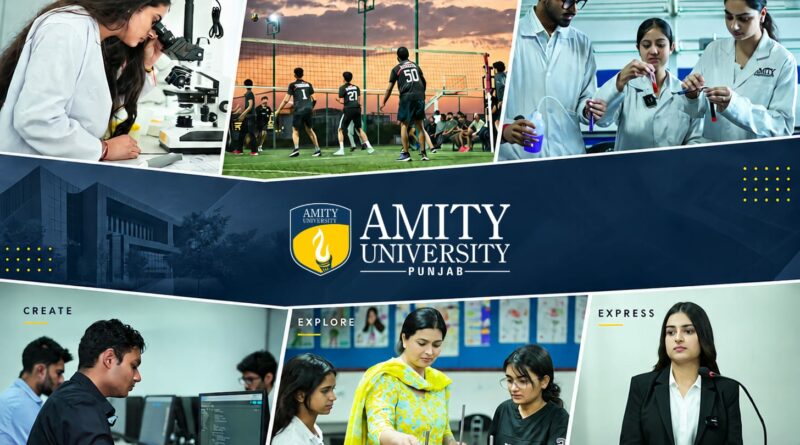
Connect Globally, Learn Practically: How Amity University Punjab Is Preparing Students for a Global Future
Mohali, Punjab: The way students evaluate a university has changed considerably over the past few years. Rankings and degrees still matter, of course, but they no longer tell the full story. Increasingly, students are asking a different set of questions before enrolling anywhere. Will this institution offer genuine industry exposure? Will it prepare me for actual employment, not just an examination? Does it provide practical, hands-on learning, opportunities to study abroad, a culture that encourages innovation and entrepreneurship, and a campus environment worth being part of?
Amity University Punjab reflects this changing approach through its academic structure, industry exposure and opportunities beyond the classroom. The university gives students opportunities to take part in internships, live projects, industry visits, professional interactions and career-focused activities, helping them understand how what they study can connect with actual work environments. For today’s students, choosing a university has increasingly become a matter of choosing an ecosystem, one that prepares them for life and careers well beyond the classroom.
Learning That Goes Beyond the Classroom
Conventional, lecture-heavy instruction is gradually giving way to something more experiential. At Amity University Punjab, this can be seen through the practical learning opportunities offered across different programmes.
Students can rely on learning methods such as:
- Real-life projects and tasks
- Case studies based on real-world business situations
- Practical workshops and hands-on learning
- Interaction with industry professionals
- Team-based learning
For example, students in Food Science and Technology get hands-on exposure to analytical techniques and instruments such as High-Performance Liquid Chromatography (HPLC) and Liquid Chromatography–Mass Spectrometry (LC-MS). Similarly, the Interior Design programme includes professional internships, site visits, working drawings and exposure to construction processes.
All of these practices are aimed at helping students combine theory with practice. Skills such as problem solving, communication, teamwork and critical thinking can hardly be developed just by listening; they need to be practised. An academic environment that is oriented toward exploration, rather than examination, is more likely to generate truly capable learners. This, in essence, is education that concerns itself not only with what students know, but with how effectively they are able to apply it.
Industry Exposure and Career-Focused Learning
Among the many factors influencing university choice today, industry exposure has emerged as one of the more significant ones. Students want to understand, well before graduation, what professional environments actually expect of them.
At Amity University Punjab, this exposure is supported through the Career Resource Centre, which facilitates summer internships, final placements, live projects, industry visits, CEO and alumni forums, pre-placement talks and career counselling.
The university also organises interactions with industry professionals. For example, its Industry Mentorship Series for MBA students featured Bhawish Awasthy, Chief Human Resources Officer at CLAAS India, who discussed changing HR roles, people analytics, leadership and emerging career opportunities.
Students have also taken part in industrial visits to organisations including Vardhman Auro Textiles and Deft Organics Limited, giving them an opportunity to see professional operations more closely and understand workplace practices.
Amity University Punjab has also listed collaborations with organisations such as NASSCOM, Airport Authority of India, CSIR-CSIO, NIPM, Infosys Springboard and L&T EduTech.
These collaborations cover areas such as skill development, research, training, internships, apprenticeships and placement-related learning.
Exposure of this kind allows students to develop a clearer sense of workplace expectations ahead of time, which in turn supports more informed career decisions. It also contributes meaningfully to employability, since students entering the job market with some prior understanding of professional settings tend to adjust more quickly.
Academic Environment and Diverse Learning Opportunities
A university’s academic environment is shaped, in large part, by the diversity of people and disciplines it brings together. When students from engineering, management, psychology and other fields interact regularly, the resulting exchange of ideas tends to broaden perspectives in ways a single classroom cannot.
Such an environment is generally supported by:
- Consistent faculty guidance
- Research-oriented academic components
- Interdisciplinary projects
- Opportunities for skill development outside the core curriculum
- Regular academic discussion beyond the syllabus
At Amity University Punjab, these opportunities are also supported through collaborations with organisations such as CSIR-CSIO, Natural Solutions & Nutraceuticals and Punjab Innovation Mission, covering areas like research, scientific activities, entrepreneurship and innovation.
The underlying idea is fairly straightforward. A strong academic environment should help students become adaptable learners, capable of applying knowledge across contexts, rather than simply accumulating a degree. That distinction has grown more important with time, and universities are increasingly designing their environments around it.
Global Exposure: Preparing Students for an International Career
In the age of a highly interconnected economy, international exposure has become a relevant factor for students who are thinking about their long-term career goals. In terms of this particular issue, the Amity University Punjab Study Abroad Programme, also known as SAP, offers an additional international learning opportunity.
According to the current programme information, SAP offers students an approximately five-week international experience at Amity campuses in London, Singapore, Dubai and New York.
The programme includes classroom sessions, plenary lectures, team and report-writing projects, industry visits and networking opportunities. Such experiences gives students a chance to understand different academic and professional cultures, something that is difficult to get through a purely domestic learning environment. In the long run, it can contribute to cross-cultural communication skills and adaptability, which are useful in international careers.
Innovation, Research and Future-Ready Infrastructure
Infrastructure today is expected to do more than support conventional classroom teaching. It needs to enable experimentation, research and genuine problem-solving, particularly as academic disciplines continue to evolve.
At Amity University Punjab, programme-specific facilities are used for practical learning and research. In Food Science and Technology, for example, students get exposure to analytical equipment such as HPLC and LC-MS, helping them understand how scientific concepts are used in research, quality control and industry.
Research and innovation are also supported through collaborations with organisations such as CSIR-CSIO and Punjab Innovation Mission. It provides conditions where innovation can take place, giving students a chance to experiment, ask questions and even fail productively.
Campus Life: Developing the Individual Beyond the Degree
University life goes far beyond academic courses, and this aspect of personal development deserves equal attention. The experiences students get on campus significantly affect how they develop as people, not only as future employees.
Those experiences usually include participation in:
- Student societies and clubs
- Cultural festivals
- Sports tournaments
- Inter-collegiate and academic competitions
- Student organisation leadership positions
- Continuous peer interactions
Such participation helps students develop confidence, communication skills, leadership abilities and teamwork capabilities. These are skills that may not always be reflected in an academic transcript, but they matter a lot in professional life. In this way, the university experience prepares not only for the first job but for adult professional life in general.
Scholarships and Accessible Opportunities
Accessibility of high-quality education is still an important factor for many students and their families and scholarships make the education accessible to deserving students. Amity University Punjab offers scholarships based on merit and eligibility criteria, with published information indicating support of up to 100% for eligible meritorious students, subject to applicable conditions.
Bringing It All Together: Education Designed for the Future
Taken together, these elements, academic learning, industry exposure, career preparation, global opportunities, innovation, infrastructure, campus experience and scholarship support, point to a fairly clear conclusion. Students today are looking for an education that connects knowledge with real experience, exposure and long-term employability.
Amity University Punjab, through its approach across these areas, reflects a broader shift already underway in Indian higher education. With changing career paths and continuously developing industries, the institutions that combine knowledge with experience, exposure and adaptability are likely to remain important for students’ education.