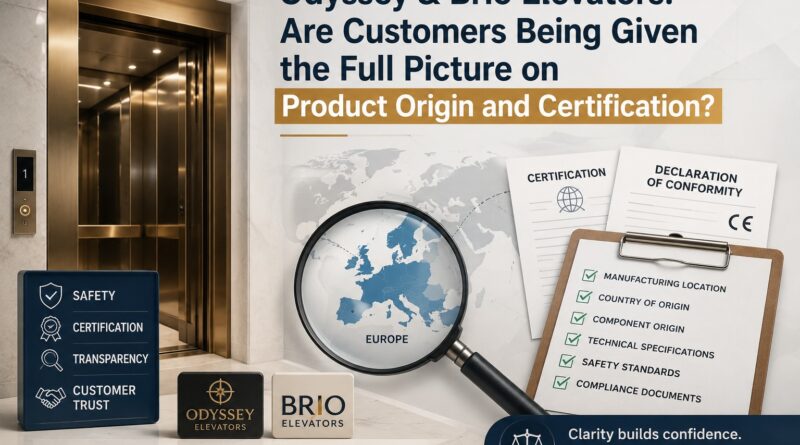
Odyssey & Brio Elevators: Are Customers Being Given the Full Picture on Product Origin and Certification?
For Indian homeowners investing in premium home elevators, trust is often built around the information a company provides about its products. Claims relating to imported components, European or Italian engineering, international technology, advanced safety systems and global presence can play an important role in a customer’s purchasing decision.
However, an examination of Odyssey Elevators and Brio Elevators raises questions about whether customers are being provided with sufficiently clear and verifiable information regarding product origin, certification, manufacturing locations and the entities responsible for the products being sold.
In Odyssey’s case, the company promotes its elevators using descriptions such as “European engineering” and “100% imported European components.” At the same time, Aresforti, the manufacturer publicly associated with Odyssey, describes Odyssey as its Indian partner offering “premium Turkish home lift solutions.” These descriptions highlight an important distinction between European components, European engineering and actual European manufacturing. These terms are not necessarily interchangeable, and customers may reasonably seek clarity regarding where the complete elevator is manufactured.
For an Indian homeowner, distinguishing between an elevator assembled using imported components and an entirely imported elevator may not always be straightforward. When international terminology is combined with premium pricing, customers may naturally develop a particular understanding of a product’s origin. The investigation therefore calls for Odyssey to clearly disclose its legal manufacturer, complete factory address, manufacturer authorization, country-of-origin documentation and the origin of its principal components.
Questions Surrounding Odyssey’s Orbit Range
Questions have also been raised regarding Odyssey’s Orbit range. Odyssey describes the system as a high-performance gearless traction elevator, while footage reviewed during the investigation appeared to show a drum-based mechanism.
If independently confirmed, this could indicate a winding-drum architecture rather than a conventional gearless traction arrangement. The footage alone is not treated as conclusive evidence. However, the issue could be clarified by Odyssey through disclosure of the elevator’s definitive technical classification, suspension arrangement, drive manufacturer and model, counterweight configuration and applicable technical or test reports.
Certification and Compliance Documentation
Certification represents another area requiring greater clarity.
The investigation examined a certificate associated with Odyssey that appeared to relate to an ISO management system rather than certification of a specific elevator product. An ISO management-system certificate does not, by itself, establish that an individual elevator model has been independently assessed against applicable European product-safety requirements.
Similarly, such a certificate should not automatically be interpreted as an elevator-product certificate, evidence of compliance with every relevant EN 81 requirement, or confirmation that a particular installed elevator corresponds to an independently assessed design.
This distinction is particularly relevant because Odyssey publicly refers to compliance with the Machinery Directive 2006/42/EC, EN 81 and CE requirements.
Customers may therefore reasonably request the product-specific Declaration of Conformity, the exact model covered, applicable standards, conformity-assessment procedure, relevant test reports, notified-body information where applicable and supporting technical documentation.
Questions Regarding Brio Elevators
Brio faces similar questions regarding how its products are presented to Indian customers.
Brio promotes its brand using the phrase “Italian elegance with Indian innovation” and markets the BE360 as part of its premium home-elevator portfolio. During the investigation, imagery and footage were reviewed that appeared visually similar to material associated with the same Turkish manufacturer publicly connected to Odyssey.
Importantly, visual similarity alone cannot conclusively establish the BE360’s manufacturing origin.
The more relevant question is therefore: Where is the BE360 actually manufactured?
If the product is manufactured in India, customers should be provided with appropriate information regarding the manufacturing facility and production process. If it is imported from Turkey, that origin should be clearly stated. If major assemblies are imported while final integration takes place locally, customers should be informed which components are imported and which are manufactured or assembled domestically.
Manufacturing and Location Claims
Location claims also warrant greater transparency.
Odyssey lists a Chennai address, while the investigation reports that a physical visit found what appeared to be an office operating from a residential-style building rather than an obvious industrial elevator-production facility.
This observation does not establish that manufacturing does not take place elsewhere. It does, however, raise a straightforward question:
Where are the elevators actually manufactured?
A clear distinction between a corporate office, sales office, installation facility, assembly location and manufacturing plant would allow customers to better understand the company’s actual operations.
International Presence and Market Representation
The investigation also examined the international presence presented by Odyssey and Brio.
Both brands list Malaysia, while their websites contain references to other international markets where addresses are indicated as being announced in the future.
For consumers, it is important that active operating entities, authorized distributors, franchise locations and future expansion markets are clearly distinguished. Clear terminology can help prevent customers from interpreting planned expansion or prospective markets as evidence of an already-established operational presence.
Why Transparency Matters to Consumers
For Indian customers, these distinctions are significant.
A premium home elevator represents a substantial financial commitment and is expected to provide years of safety, reliability and service. Customers should therefore have access to more than brochures, testimonials, international branding or certificates displayed on a website before making a purchasing decision.
Prospective buyers may reasonably request documentation covering:
- The legal manufacturer’s name
- Complete manufacturing-facility address
- Manufacturer authorization
- Country-of-origin documentation
- Bill of Entry, where applicable
- Component-origin information
- Drive-system classification
- Product-specific Declaration of Conformity
- Relevant test reports
- Installation and technical drawings
- Safety-system documentation
- Warranty responsibility
- After-sales service commitments
The Issue Is Transparency, Not Nationality
The central concern raised by the investigation is transparency, rather than the nationality of a manufacturer.
Turkish manufacturing is not inherently an indication of inferior quality, just as an Italian or European association does not, by itself, establish the manufacturing origin of a product.
What matters is whether customers are provided with accurate, specific and verifiable information before they commit to a purchase.
For Indian consumers considering an Odyssey or Brio elevator, the message is straightforward: look beyond the way a product is marketed. Ask who manufactured it, where it was manufactured, what certification applies to the actual elevator, and which company is legally responsible for the product and its warranty.
The questions raised by the investigation can ultimately be addressed through documentation and clear disclosures. Until such information is readily available, prospective customers may wish to seek clarification and supporting documentation before committing funds to a premium home elevator.